#include <rw_driver.h>#include <rw/_defs.h>#include <type_traits>#include <rw_printf.h>#include <stdlib.h>#include <stddef.h>
Include dependency graph for 20.meta.trans.other.cpp:
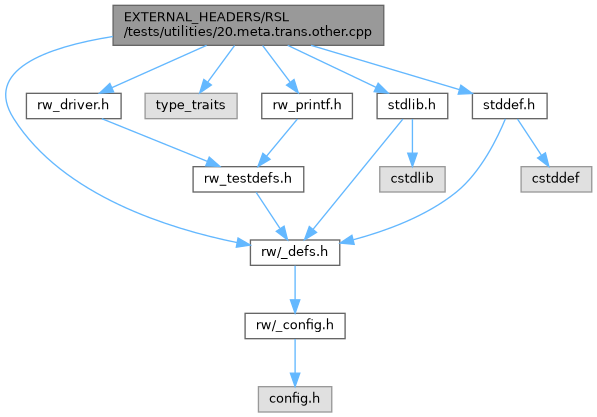
Go to the source code of this file.
Data Structures | |
| struct | is_char< T > |
| struct | is_char< char > |
| struct | null_t |
| struct | aligned_union_tester< Len, T1, T2, T3, T4, T5, T6, T7, T8 > |
| struct | struct_t |
Macros | |
| #define | TEST(Size, Align) |
| #define | TEST(Size) |
| #define | TEST(Len, T1) aligned_union_tester<Len,T1>::test(__LINE__,#T1) |
| #define | TEST(Len, T1, T2) aligned_union_tester<Len,T1,T2>::test(__LINE__,#T1,#T2) |
| #define | TEST(Len, T1, T2, T3, T4, T5) aligned_union_tester<Len,T1,T2,T3,T4,T5>::test(__LINE__,#T1,#T2,#T3,#T4,#T5) |
| #define | TEST(Trait, TypeT, TypeU) |
| #define | TEST(Cond, Expect) test_enable_if(__LINE__, #Cond, Cond, Expect) |
| #define | TEST(Cond, Expect) test_enable_if(__LINE__, #Cond, Cond, Expect) |
| #define | TEST(Trait, Select, TypeT, TypeU, TypeV) |
Enumerations | |
| enum | enum_t { E_a = 1 } |
Functions | |
| template<class T > | |
| int | enabled_if_char (typename std::enable_if< is_char< T >::val >::type *=0) |
| template<class T > | |
| int | enabled_if_char (typename std::enable_if<!is_char< T >::val >::type *=0) |
| int | _cond_if_char (void *) |
| int | _cond_if_char (long *) |
| template<class T > | |
| int | cond_if_char () |
| void | test_trait (int line, bool select, const char *trait, const char *typeT, const char *typeU, bool success) |
| void | test_trait (int line, const char *trait, const char *typeT, const char *typeU, bool success) |
| void | test_enable_if (int line, const char *typeT, int got, int exp) |
| void | test_aligned_storage (int line, size_t exp_sz, size_t got_sz, size_t exp_al, size_t got_al) |
| size_t | max8 (size_t a1, size_t a2, size_t a3, size_t a4, size_t a5, size_t a6, size_t a7, size_t a8) |
| int | main (int argc, char *argv[]) |
Macro Definition Documentation
◆ TEST [1/9]
| #define TEST | ( | Cond, | |
| Expect | |||
| ) | test_enable_if(__LINE__, #Cond, Cond, Expect) |
◆ TEST [2/9]
| #define TEST | ( | Cond, | |
| Expect | |||
| ) | test_enable_if(__LINE__, #Cond, Cond, Expect) |
◆ TEST [3/9]
| #define TEST | ( | Len, | |
| T1 | |||
| ) | aligned_union_tester<Len,T1>::test(__LINE__,#T1) |
◆ TEST [4/9]
◆ TEST [5/9]
| #define TEST | ( | Len, | |
| T1, | |||
| T2, | |||
| T3, | |||
| T4, | |||
| T5 | |||
| ) | aligned_union_tester<Len,T1,T2,T3,T4,T5>::test(__LINE__,#T1,#T2,#T3,#T4,#T5) |
◆ TEST [6/9]
| #define TEST | ( | Size | ) |
Value:
{ \
typedef std::aligned_storage<Size>::type storage_t; \
test_aligned_storage(__LINE__, \
Size, sizeof (storage_t), 0, \
std::alignment_of<storage_t>::value); \
} typedef void __dummy
Definition rw_alg_test.h:344
◆ TEST [7/9]
| #define TEST | ( | Size, | |
| Align | |||
| ) |
Value:
{ \
typedef std::aligned_storage<Size, Align>::type storage_t; \
test_aligned_storage(__LINE__, \
Size, sizeof (storage_t), Align, \
std::alignment_of<storage_t>::value); \
} typedef void __dummy
◆ TEST [8/9]
| #define TEST | ( | Trait, | |
| Select, | |||
| TypeT, | |||
| TypeU, | |||
| TypeV | |||
| ) |
Value:
test_trait(__LINE__, Select, #Trait, #TypeT, #TypeU, \
std::is_same<Trait<Select,TypeT,TypeU>::type, TypeV>::value)
void test_trait(int line, bool select, const char *trait, const char *typeT, const char *typeU, bool success)
Definition 20.meta.trans.other.cpp:97
◆ TEST [9/9]
| #define TEST | ( | Trait, | |
| TypeT, | |||
| TypeU | |||
| ) |
Value:
test_trait(__LINE__, #Trait, #TypeT, #TypeU, \
std::is_same<Trait<TypeT>::type, TypeU>::value)
Enumeration Type Documentation
◆ enum_t
| enum enum_t |
| Enumerator | |
|---|---|
| E_a | |
Definition at line 410 of file 20.meta.trans.other.cpp.
Function Documentation
◆ _cond_if_char() [1/2]
| int _cond_if_char | ( | long * | ) |
Definition at line 80 of file 20.meta.trans.other.cpp.
◆ _cond_if_char() [2/2]
| int _cond_if_char | ( | void * | ) |
Definition at line 74 of file 20.meta.trans.other.cpp.
◆ cond_if_char()
template<class T >
| int cond_if_char | ( | ) |
Definition at line 86 of file 20.meta.trans.other.cpp.
◆ enabled_if_char() [1/2]
Definition at line 60 of file 20.meta.trans.other.cpp.
◆ enabled_if_char() [2/2]
Definition at line 68 of file 20.meta.trans.other.cpp.
◆ main()
| int main | ( | int | argc, |
| char * | argv[] | ||
| ) |
Definition at line 500 of file 20.meta.trans.other.cpp.
◆ max8()
| size_t max8 | ( | size_t | a1, |
| size_t | a2, | ||
| size_t | a3, | ||
| size_t | a4, | ||
| size_t | a5, | ||
| size_t | a6, | ||
| size_t | a7, | ||
| size_t | a8 | ||
| ) |
Definition at line 227 of file 20.meta.trans.other.cpp.
◆ test_aligned_storage()
| void test_aligned_storage | ( | int | line, |
| size_t | exp_sz, | ||
| size_t | got_sz, | ||
| size_t | exp_al, | ||
| size_t | got_al | ||
| ) |
Definition at line 126 of file 20.meta.trans.other.cpp.
◆ test_enable_if()
| void test_enable_if | ( | int | line, |
| const char * | typeT, | ||
| int | got, | ||
| int | exp | ||
| ) |
Definition at line 118 of file 20.meta.trans.other.cpp.
◆ test_trait() [1/2]
| void test_trait | ( | int | line, |
| bool | select, | ||
| const char * | trait, | ||
| const char * | typeT, | ||
| const char * | typeU, | ||
| bool | success | ||
| ) |
Definition at line 97 of file 20.meta.trans.other.cpp.
◆ test_trait() [2/2]
| void test_trait | ( | int | line, |
| const char * | trait, | ||
| const char * | typeT, | ||
| const char * | typeU, | ||
| bool | success | ||
| ) |
Definition at line 109 of file 20.meta.trans.other.cpp.
